

Last week, I was sitting in the back of a Gojek car, telling the uncle at the driver’s seat about my relationship problems, work stress, and even my political views on the current state of the world. I’ll never see this man again, yet the conversation flowed naturally from me.
There was no hesitation or fear. Yet, when I entered the lift, I avoided contact with my neighbour of 20 years. It was an instinctive behaviour that many of us know too well. In fact, a recent colleague shared a story that exposes this odd contradiction.
Years ago, she overheard her neighbour mutter an aggressive comment on a bus. It was not directed at her, but it left her uneasy. She decided this was someone to avoid. For years, she maintained that quiet distance.
Then one afternoon on the bus, her neighbour complimented her outfit. My colleague froze. Though friendly and harmless, she was hesitant to say anything – even a thanks. Why have we engineered an environment where strangers feel safer than neighbours?
Stranger on a train phenomenon
Psychologist Zick Rubin coined the phrase in the 1970s after he observed people routinely disclosing intensely personal information to individuals they’ll never see again. The person beside them on a plane, their hairstylist, bartenders, taxi drivers.
A 2011 study in the Journal of Consumer Research found that participants willingly shared sensitive personal information with strangers in transient settings, details they would never reveal to their friends or neighbours.

The reasoning is quite simple. Temporary proximity triggers false intimacy. When forced into close quarters with a stranger like a crowded plane or a shared taxi, we experience what researchers call “closeness without consequences”.
The stranger listens, and then they vanish. This anonymity lowers the social cost of honesty. We respond by letting our guard down and sharing personal information we would usually reserve for our close relationships.
Why Neighbours Feel More Dangerous
My Gojek driver disappears after 30 minutes. My neighbour witnesses my life daily. The early morning garbage disposals in my pyjamas, the arguments in the corridor, the groceries I bring home.
That’s not community. It’s surveillance that I did not consent to. It’s what researchers call “proximity paradox”.
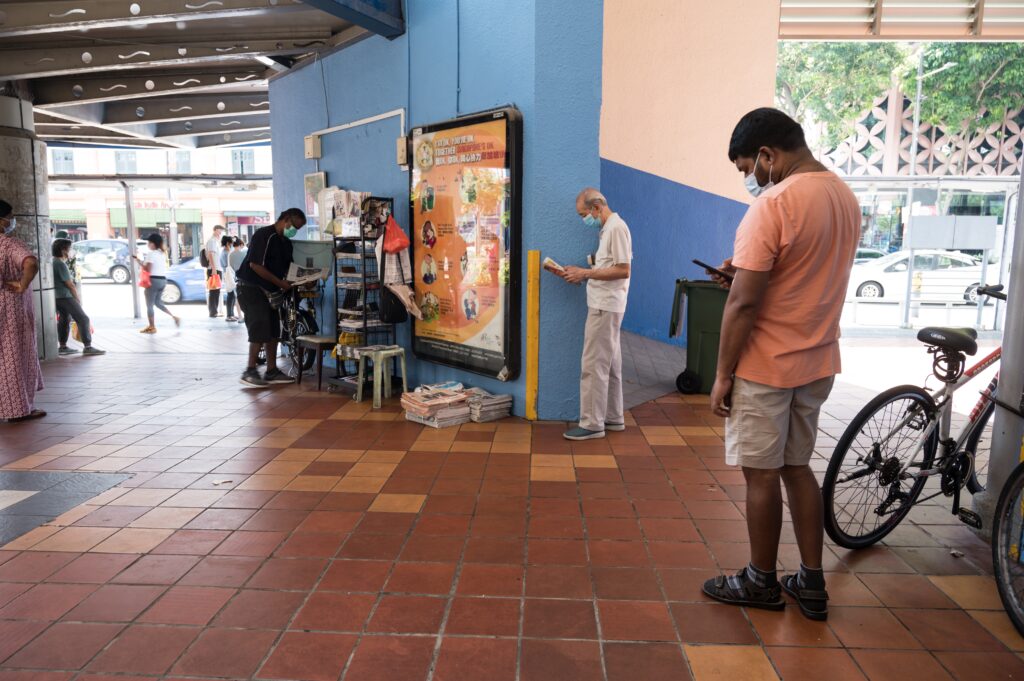
The same closeness that can create connection can also amplify discomfort. Unlike a stranger, a neighbour can affect your daily life. A single negative moment can feel more impactful because you cannot simply walk away from it.
When my colleague heard the aggressive comment by her neighbour on the bus, she made a calculation. This person could make her daily life uncomfortable. Therefore, it would be better to maintain a distance.
Singapore’s high-density living intensifies this. HDB flats were designed with shared corridors and void decks to encourage community. But these shared spaces can make minor tensions feel larger and small misunderstandings feel personal.
We misread expressions, assume hostility, and quietly avoid.
The Cost of Keeping Our Distance
Before they got off the bus, my colleague thanked her neighbour. The small exchange became daily greetings, then short chats about work and life. Years of silence changed because of one kind word.
She realised she had judged her neighbour’s entire character from one overheard comment and had been prepared to maintain that belief indefinitely.
How many of us do the same?
Research suggests we routinely underestimate others’ interest in connecting with us. Psychologists find that we wrongly believe deeper conversations will be more awkward and less enjoyable than they actually are.
We rely on surface-level conversation or completely avoid people because we are protecting ourselves from imagined danger while ignoring what doing so costs us.
By avoiding our neighbours, we lose more than we realise. These casual relationships offer practical help, fresh perspectives, and a sense of belonging in our community. But only if we actually talk to each other.
Reconsider the Risks
This Christmas, many Singaporeans will engage in volunteer events, participate in charity drives, and post about not forgetting those currently alone. Meanwhile, we ignore those living a wall away from us.

I’m not suggesting forced friendships. But the research is clear. The stranger on the train gets our attention because they’re temporary. The neighbour gets our silence because they’re permanent, and we’ve decided that keeps us safe.
And maybe it does. But when self-protection means someone falls and no one checks, when a bad facial expression gets mistaken for hostility, when festive loneliness gets talked about yearly, maybe our risk calculation is backwards.
My colleague’s neighbour is spending Christmas at her house. They’re not best friends. But she knows her name. She has her contact details. If something’s wrong, they’ll check.
That’s not impressive. It’s basic neighbouring we’ve talked ourselves out of.
What’s stopping you from making that first step?
Share your thoughts with us