
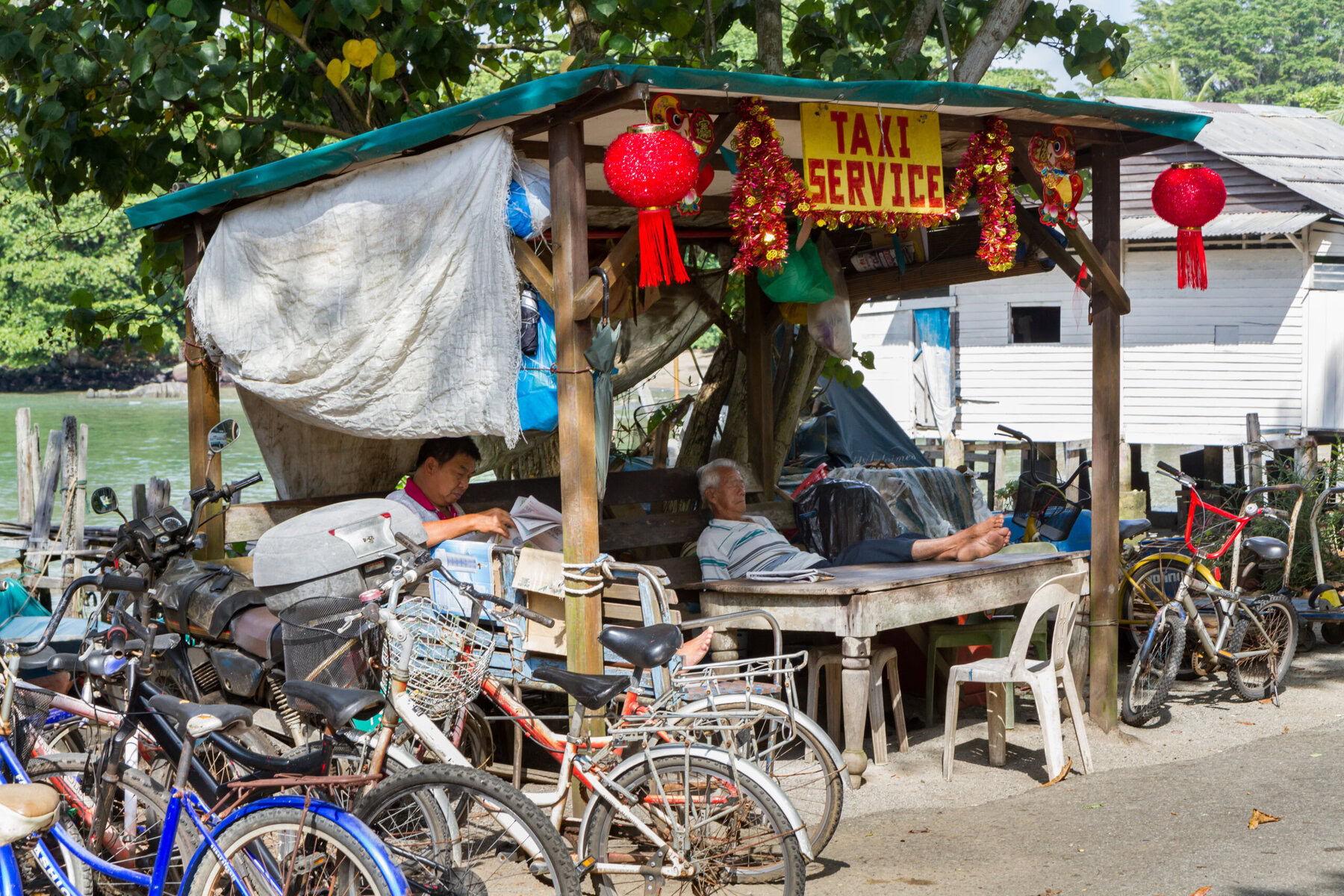
Pulau ubin is often described as a glimpse into Singapore’s past. Once home to thriving kampungs, its remaining heritage is kept alived not oly through the places that remain, but also through the stories passed down by those determined to preserve them.
Every June, Ubin Day celebrations include a Malay Kampung Heritage Tour. It typically concludes with Wan, creator of Wan’s Ubin Journal, reciting the azan (an Islamic call to prayer). The moment is intended not to be a religious ceremony but rather to recreate the soundscape of Kampung Surau. Doing so allows participant to imagine what life on Pulau Ubin might have been like when the village mosque still stood.
For Wan, it is also an invitation to pause. As the tour draws to a close, participants are encouraged to reflect on the stories they’ve heard regarding the island’s peoples, their customs and traditions amidst the sounds of crashing waves, rustling leaves and cicadas that continue to define Ubin’s landscape today.
For years, the experience had been met with overwhelmingly positive feedback. Some participants described it as the highlight of the the tour, while others were even moved to tears.
That changed in May 2026, when Wan was informed by the National Parks Board that a member of the public who had attended the heritage tour had lodge a complaint. An investigation was requested into his recitation of the azan. According to Wan, the context and intention behind the segment were subsequently clarified between the relevant parties. The matter was not pursued further.
However, after sharing his experience on social media, the incident quickly grew traction online. What started out as a complaint about a heritage tour evolved into a wide conversation regarding race, religion, and the place of cultural expression in Singapore. Opinions ranged from support and solidarity to criticism. with some comments turning personal.
However, not all comments were negative and Wan was still met with an outpouring of support. In particular, much of the support came from his past tour participants.
Many shared that the azan had been clearly framed as part of Pulau Ubin’s history. They described it as an immersive experience to the island’s past soundscape rather than a religious obligation. More importantly, many urged others to consider the context before passing judgement.
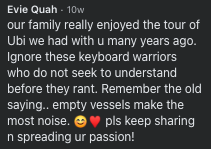
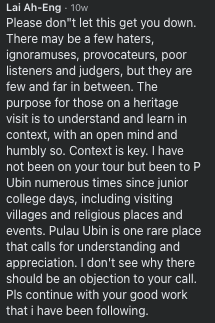
“I felt disappointed as the context and intention of the segment was misunderstood,” Wan shared. He explained that the complaint appeared to suggest he had “inflicted religious wounds upon others for performing a religious ceremony in a public space”, an interpretation he said did not reflect the educational intent behind the heritage experience.
A Conversation Beyond One Tour
For some, the discomfort may not necessarily stem from the azan itself. Instead, the concerns may have stemmed from whether a religious act belongs within a public heritage platform. Visitors unfamiliar with the context could feel uncertain about whether they are observing a cultural demonstration or participating in a religious experience.
These valid concerns raised a broader question: how do we learn about another’s culture and history without losing sight of the intentions behind them?
Should tour participants have been given clearer notice that the azan would be recited as part of the tour? Wan clarified that the segment has always been prefaced by explaining its historical significance and anyone who may feel uncomfortable is allowed to step away.

For 36-year-old Nizam, the issue was less about the recitation itself and more about how its intention had been misunderstood.
“I feel like such an incident is a minor occurrence. Such comments online show poorly how some people view or accept what seems to be a historical showcase,” he comments.
Nizam likens Wan’s recreation of the azan to the immersive experiences found in museums and heritage sites. There, archival recordings, speeches or ambient sounds are used to help visitors better understand the past.
Ultimately, whether through online discussions or personal conversations, a common thread emerged: context matters. Cultural and religious practices can evoke different responses. However, many feel that understanding can only begin when people are open to opportunities to learn why a tradition exists before drawing conclusions.
Beyond Tolerance
For many Singapores, learning about another culture isn’t unfamiliar. Growing up in a multi-cultural society, formal lessons in school and personal life experiences have expose many to various cultures and religions in Singapore. However, true understanding goes beyond simply living alongside one another. Rather, it begins with curiosity, respect and a willingness to ask questions.
Some of 38-year-old Hid’s most memorable experiences came from stepping into traditions that weren’t her own.
“I was a bridesmaid at a Hindu wedding,” she shared, “I’ve followed my friends to church, helped with weddings and been involved in their prayers. It’s nice to be involved, and not just be a bystander.”
The key, however, isn’t whether someone chooses to participate, but whether they are given the choice to.
“If I don’t feel comfortable, I do voice it out,” Hid said. “In the case of Wan’s experience, I believe that the participant should have been given the opportunity to step away, if they felt uncomfortable in any way.”
That distinction between learning and participating surfaced repeatedly.

“Learning about a religion is passive,” said Min, 25. “You’re observing, studying and experiencing some aspect of it. Participating is actively engaging in a practice or ritual.”
While participation can offer a deeper understanding, Min believes simply being present is already an opportunity to broaden one’s perspective.
“It’s part of learning about a community that’s not your own. It’s important to be respectful and have an open mind,” she clarifies.
In many ways, that was also Wan’s intention. As a tour centered on the history of a former Malay kampung, the experience naturally included elements of everyday life that were deeply intertwined with faith. The azan was presented not as an invitation to participate in a religious act, but as one of many cultural touchpoints that shaped the community’s identity.
For Nizam, cultural experiences, even those that may initially feel unfamiliar, are an opportunity rather than something to shy away from.
“Though uncomfortable, it is still insightful,” he said. “To be against understanding and respecting is to be ignorant.”
Many also reflected that misunderstandings are often born not from malice, but from unfamiliarity.
“When I was young, I never fully understood the meaning behind carrying a kavadi during Thaipusam,” Min admitted. “When I grew older and asked my friends about it, I understood it was a form of devotion, gratitude and religious commitment.”
Hid echoed a similar sentiment: this time within her own faith.
“Even in my own religion, I’ve misunderstood. We just followed our parents, but didn’t always know why we were doing certain things. When we asked, we got the answers.”
Perhaps that’s the quiet value of cultural exchange. It isn’t about knowing everything. It’s about asking questions before making assumptions.
As Nizam puts it: “Misunderstandings are bound to happen when we’re uneducated about any practices. It’s best to approach them with an open mind and humility.”
In many ways, that was the lesson at the heart of Wan’s experience. The conversation surrounding his heritage tour was never simply about the recitation of the azan, it became a reflection of how we respond to cultures and traditions that may feel unfamiliar to us.
Can We Still Make Space for Culture in Singapore Today?
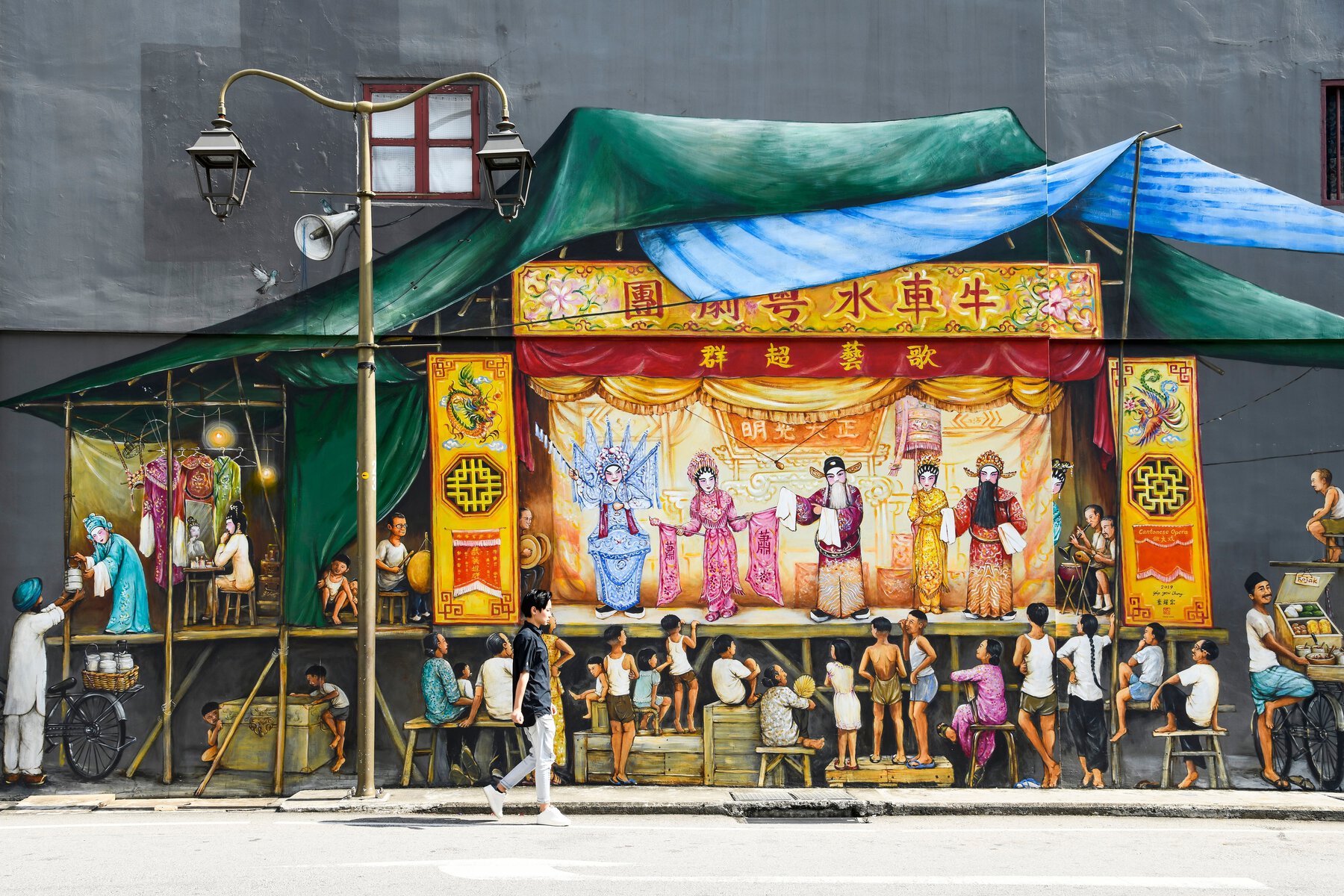
The answer is not always straightforward. But we can ask questions before making assumptions. We can choose to listen before we react. Allow others the opportunity to share a part of themselves without immediately feeling threatened by it.
From the conversations we’ve heard and the online comments, it is evident that Singaporeans are still curious. They are willing to step into unfamiliar spaces, learn about traditions beyond their own and appreciate the richness of a multicultural society. But curiosity alone isn’t enough.
It must be accompanied by graciousness and kindness.
Kindness reminds us that behind every tradition is a person. Behind every cultural practice is a story.
For Wan, sharing Pulau Ubin’s heritage has always been an act of remembrance: of preserving stories, voices and a way of life that risks fading with time. For others, learning about a culture outside their own begins with a simple invitation: to observe, to ask, and to understand.
Perhaps that’s what “regardless of race, language or religion” asks of us today.
What does “regardless of race, language or religion” mean to you?
Share your thoughts with us




One Response
Singapore’s multicultural environment makes it easier for people to appreciate and understand different cultures and religions from a young age.Telkom University Jakarta
Share your thoughts with us